CCRC - THE COLD HARD FACTS
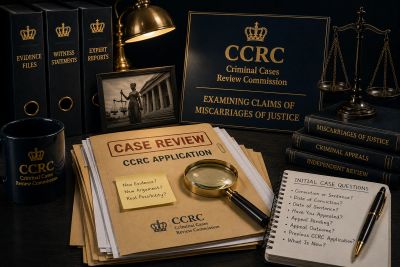
What Is the CCRC?
The Criminal Cases Review Commission is the independent public body responsible for reviewing potential miscarriages of justice in England, Wales and Northern Ireland.
It can review convictions and sentences and, where the statutory test is met, refer a case back to the appropriate appeal court.
It Is Not Another Court of Appeal
The CCRC does not simply reconsider your case because you maintain your innocence or believe that the jury or Court of Appeal reached the wrong decision.
Ordinarily, there must be new evidence or a new legal argument capable of making a material difference to the case.
Your Application Matters
Submitting an application does not automatically result in a full investigation.
The CCRC will consider the application and relevant material to determine what, if anything, requires further investigation. Where issues are identified which require additional work, the case may progress to more detailed investigation.
This is why the quality and substance of the initial application matters.
Give Them a Reason to Investigate
A properly prepared application should identify as clearly as possible what is new, what may have gone wrong, why it matters and what further investigation could potentially establish.
You do not necessarily need to possess all of the evidence yourself. The CCRC has statutory powers that can enable it to obtain material which an ordinary applicant cannot.
But those powers do not mean that every application results in extensive enquiries, witness interviews, forensic testing or the instruction of experts.
The application needs to give the CCRC a properly reasoned basis for considering why further investigation may be required.
HAVE YOU ALREADY APPEALED?
The Criminal Cases Review Commission is not intended to replace the normal appeal process.
Ordinarily, before applying to the CCRC, you should first have attempted to appeal your conviction or sentence through the courts in the usual way. The CCRC was established principally to consider cases where the normal rights of appeal have already been used.
If you have not previously appealed, the CCRC will usually direct you back to the appropriate court to pursue an appeal first.
Importantly, being outside the normal appeal time limit does not, by itself, mean that you can bypass this process. An application for permission to appeal can still be made out of time. Similarly, having previously been advised by a solicitor or barrister that there are no Grounds of Appeal, or being unable to obtain legal representation, does not automatically allow you to bypass the normal appeal route.
There is an exception.
The CCRC can consider and refer a case where there has been no previous appeal if exceptional circumstances exist. However, the Commission makes clear that such circumstances are very rare and are considered according to the individual facts of the case.
If your first appeal is currently pending, the CCRC cannot review your case at that stage.
You will ordinarily need to allow the appeal process to conclude before asking the Commission to review the conviction or sentence. In simple terms: the CCRC is generally a route to consider after the ordinary appeal process — not instead of it.
THE REAL POSSIBILITY TEST
The CCRC cannot refer a case back to an appeal court simply because it believes that something may have gone wrong. It must apply a statutory test.
Before making a referral, the Commission must consider that there is a “real possibility” that the conviction, verdict, finding or sentence would not be upheld if the case were referred to the appropriate appeal court.
That does not mean that the CCRC has to be certain that the appeal will succeed.
The threshold can be less than a probability or likelihood, but it must amount to more than merely an outside chance or bare possibility. The CCRC must be satisfied that there is a genuine prospect of the appeal court reaching a different conclusion.
For a conviction, this will ordinarily depend upon new evidence or a new argument which was not raised at trial or during the previous appeal proceedings.
For a sentence, the legislation refers to an argument on a point of law or information which was not previously raised. This distinction is important.
The CCRC does not decide whether your conviction is unsafe. Nor does it quash the conviction itself. Its task at this stage is to decide whether the information before it creates a real possibility that the appeal court would do so.
If the CCRC refers the case, it is the appeal court — not the CCRC — which ultimately decides the outcome. The question is therefore not simply: “Has something gone wrong?”
It is: “Could what has gone wrong realistically cause the appeal court to reach a different decision?”
SOMETHING NEW – WHAT DOES THAT ACTUALLY MEAN?
One of the most important requirements of a CCRC application is normally the existence of something new.
In an application concerning a conviction, this will usually mean evidence or an argument which was not raised at the trial, on appeal, or in an application for permission to appeal.
Simply repeating arguments which have already been considered by the jury, trial judge or appeal court will not ordinarily provide the CCRC with a basis for referring the case.
But “new” does not necessarily mean something which has only recently come into existence.
Evidence may have existed at the time of the original proceedings but never have been placed before the court. There may be previously undisclosed material, a witness who was never interviewed, forensic material capable of examination using techniques which were not previously available, or information which only becomes significant when considered alongside other evidence. Recent CCRC referrals demonstrate that previously undisclosed evidence and advances in forensic techniques can become highly significant.
Equally, a new legal argument may arise from a subsequent development in the law or from an argument which was never advanced during the original proceedings. The important questions are therefore:
What is new?
Why wasn't it considered previously?
What does it establish?
And could it realistically make a difference to the outcome?
Finding something new is only the beginning. It must also be sufficiently significant to contribute to the real possibility that the appropriate appeal court would reach a different conclusion.
New does not automatically mean important — and important does not automatically mean sufficient. The evidence or argument has to be examined in the context of the case as a whole.
The legislation does permit the CCRC to make certain referrals despite the usual requirement for a new argument or evidence where exceptional circumstances justify doing so. This is an exception rather than the normal route and will depend upon the particular circumstances of the case.
THE CCRC HAS POWERS THAT YOU DON'T
One of the most important advantages of the Criminal Cases Review Commission is its ability to obtain material which an applicant, family member, solicitor or private investigator may be unable to access.
Under section 17 of the Criminal Appeal Act 1995, the CCRC can require public bodies to provide documents or other material which may assist its review. This can include material held by the police, Crown Prosecution Service, courts, local authorities and other public bodies.
These powers can extend to highly sensitive material, including information which was never disclosed to the defence and material subject to Public Interest Immunity considerations.
The CCRC also has powers under section 18A to apply to the Crown Court for an order requiring a private individual or organisation to provide access to relevant material which may assist its work.
Its investigative work can go considerably further. Where the CCRC considers it appropriate, it can interview or re-interview witnesses, arrange forensic testing and obtain new expert evidence, including matters such as DNA testing and psychological reports.
But having these powers does not mean that the CCRC will automatically use them simply because an applicant asks it to.
The CCRC decides for itself what material it needs to obtain and what investigations are necessary. Its own guidance specifically asks applicants to concentrate on what they believe is new and how it might make a difference.
This is why a properly prepared application can be so important.
If you believe that undisclosed police material exists, for example, it is considerably more useful to explain what material you believe exists, why you believe it exists, who is likely to hold it and what relevance it may have to the conviction than simply asking the CCRC to obtain the entire police file.
Similarly, if further expert examination is required, the issue should wherever possible be identified and explained: what requires examination, why the existing evidence may be questionable and what a further expert examination could potentially establish.
You may not be able to obtain the evidence yourself.
But you can give the CCRC a properly evidenced reason to look for it.
THE CCRC CAN INVESTIGATE — BUT THEY NEED A REASON TO
Every application received by the CCRC is considered. However, submitting an application does not mean that the Commission will automatically embark upon an extensive investigation of everything that may have happened in your case.
The CCRC will initially check matters such as whether you have already attempted to appeal, whether it has the legal power to deal with the case and whether you have previously applied concerning the same conviction. It will obtain the papers it considers necessary to begin considering the application.
It then considers the issues raised and decides what further work, if any, is required. Where the CCRC considers that issues require further investigation, the case can be allocated to a Case Review Manager for that work. This distinction is extremely important.
The CCRC has considerable investigative powers, but it decides which enquiries are necessary. It will consider requests for particular investigations, but its own guidance makes clear that it will undertake work where it considers that work relevant and of potential evidential value.
A CCRC application should therefore do considerably more than simply state:
“I am innocent — please investigate my case.”
Wherever possible, it should identify what is said to be wrong, what is new, what evidence supports the concern, why it could matter to the conviction or sentence and what further enquiries might establish.
You are not necessarily expected to possess every piece of evidence before applying. The CCRC itself says that applicants do not have to present a fully completed evidential case, but they should provide as much information as possible and point the Commission towards where it should be looking.
That can make the difference between simply identifying a suspicion and presenting a properly reasoned line of enquiry.
If expert examination may be required, explain what needs examining and why.
If undisclosed material may exist, identify what you believe exists, where it may be held and why it matters.
If a witness should be re-interviewed, explain what issue requires clarification and what the witness may be able to establish.
The objective is not to tell the CCRC how to conduct its investigation. It is to give the Commission sufficient evidential reason to consider whether that investigation should be undertaken.
A properly prepared application does not simply ask the CCRC to find a miscarriage of justice. It shows them where, and why, they may need to look.
WHAT DOES A PROPERLY PREPARED APPLICATION INVOLVE?
There is no requirement to instruct a solicitor or other representative before applying to the CCRC. The application itself is free, and the CCRC makes clear that applicants can apply without legal representation.
However, there is an important difference between being able to complete an application form and undertaking a detailed review and investigation of the case before that application is submitted.
A properly prepared CCRC application should begin by establishing the complete history of the case:
• What were you convicted of?
• When were you convicted and sentenced?
• What was the prosecution case?
• What defence was advanced at trial?
• Did you appeal?
• What Grounds of Appeal were previously advanced?
• What did the Court of Appeal decide and why?
• Have you previously applied to the CCRC?
• If so, what issues did it consider and what was its decision?
That history matters because the CCRC specifically considers previous appeals and previous CCRC applications when it receives a case. It also recommends providing as much information as possible about the conviction and previous appeals because missing information can delay the review. The next question is perhaps the most important:
WHAT IS NEW?
That may involve new evidence, a new witness, previously undisclosed material, developments in forensic science, a new expert opinion, a new legal argument or another issue which was not previously considered. But simply identifying something as “new” is not enough.
A properly prepared application should seek to establish what the new material proves, how reliable it is, why it was not previously considered and how it affects the case when placed alongside the evidence already heard by the court.
The CCRC itself advises applicants to focus on what they believe is new and how it might make a difference. It does not require an applicant to arrive with a completely finished evidential case, but it asks applicants to provide as much information as possible and point it towards where it should be looking.
This may require substantial work before the application is made: reviewing the original case papers, previous appeal decisions, unused material and legal files; reconstructing chronologies; tracing witnesses; obtaining statements; examining contradictions; identifying expert issues; and establishing what further evidence may exist but cannot presently be obtained without the CCRC's statutory powers.
The objective is not to make the application longer. The objective is to make every issue raised capable of being understood, investigated and properly assessed.
A hundred allegations that cannot be substantiated may achieve very little.
One properly evidenced issue capable of undermining the safety of a conviction may be considerably more important.
LEGAL AID & CCRC APPLICATIONS
You do not need a solicitor to apply to the CCRC.
The CCRC does not charge applicants for reviewing their cases and there is no fee for submitting an application. The Commission itself makes clear that an applicant can apply without legal representation.
However, that should not be confused with saying that professional assistance cannot be valuable.
The CCRC acknowledges that case reviews can involve complicated legal issues and that a good lawyer can assist an applicant in understanding them. A solicitor may also be able to obtain funding under the Legal Aid scheme to assist with a CCRC case.
Legal Aid for this work is generally provided as Advice and Assistance, rather than the CCRC itself providing or funding your representative. As with criminal appeal work, publicly funded assistance necessarily operates within the Legal Aid scheme's rules, eligibility requirements and remuneration arrangements. That can become particularly important in a substantial CCRC case.
A properly prepared application may require examination of the original prosecution case, defence case, unused material, previous solicitors' files, trial documentation, previous Grounds of Appeal, Court of Appeal decisions and any earlier CCRC applications.
It may also require potential new evidence to be investigated, witnesses traced and interviewed, documents obtained, chronologies reconstructed and specialist or expert issues identified.
The important question is therefore not simply whether Legal Aid is available.
It is whether the funding available in the individual case permits the level of review, investigation and preparation that the case actually requires.
PRIVATELY FUNDED CCRC PREPARATION
The CCRC does not charge you to apply and does not charge you for any investigation it decides to undertake.
Private funding therefore does not pay Principle 7 Global to do something that the CCRC would otherwise charge you for. The distinction is important. What you are paying for is the independent review, investigation and preparation undertaken on your behalf before and, where appropriate, during the CCRC process.
The CCRC is independent. It does not act as your solicitor, investigator or representative and it does not work for you. It decides for itself what documents it will obtain and what enquiries it considers necessary.
Principle 7 Global approaches the case from the client's perspective. Our purpose is to examine the available evidence, identify what may have gone wrong, establish what is genuinely new and investigate those matters which can reasonably be investigated before asking the CCRC to exercise its own statutory powers.
Depending upon the case, privately funded preparation may include:
• obtaining and analysing the available case papers;
• examining the original prosecution and defence cases;
• reviewing previous Grounds of Appeal and appeal decisions;
• examining previous CCRC applications and decisions;
• reviewing unused and disclosed material available to us;
• examining the previous solicitors' files and defence preparation;
• identifying potential new evidence or arguments;
• tracing and interviewing potential witnesses;
• obtaining witness statements;
• constructing detailed chronologies;
• identifying contradictions and evidential anomalies;
• identifying matters which may require specialist or expert examination; and
• identifying relevant material which may exist but which can only realistically be obtained through the CCRC's statutory powers.
The CCRC specifically encourages applicants to explain what is new and how it might make a difference, and says that applicants should point it towards where it should be looking. That is where thorough preparation can become particularly valuable. Rather than simply asking:
“Will you obtain the police files?”
We should, wherever the evidence permits, be able to explain what material we believe may exist, why we believe it exists, where it is likely to be held and why it could be important. Rather than simply asking:
“Will you instruct another expert?”
We should seek to identify what aspect of the existing evidence requires further examination, why that examination may be significant and what further expert work could potentially establish.
The final decision about what enquiries to undertake remains entirely with the CCRC. The Commission expressly states that it decides what enquiries it considers necessary in each case. Private funding cannot buy a CCRC referral.
What it can provide is the time and resources necessary to investigate the issues properly and present the Commission with a clear, evidence-based explanation of what may have gone wrong, what is new, why it matters and where further investigation may lead.
You are not paying us simply to complete an application form. You are paying us to investigate and prepare the case behind it.
HOW LONG CAN A CCRC REVIEW TAKE?
There is no single timescale for a CCRC case. The time required depends upon the complexity of the issues raised, the amount of material involved, what records need to be obtained and whether further investigation, witness enquiries, forensic examination or expert evidence is required.
The CCRC states that a straightforward review might take only a few weeks, while a complicated case can take many months — or, in the most complex investigations, even years.
The Commission currently aims to complete at least 85% of all cases within 12 months of receiving the application. However, the latest published figures, to the end of June 2026, show that approximately 80.43% of cases involving applicants in custody and 74.75% of cases involving applicants at liberty were being completed within that period.
For cases which are actually allocated for review, the CCRC has a target of making a decision within 30 weeks from the review beginning.
Current performance is longer. At the end of May 2026, the average review time was approximately:
• 47 weeks – applicants in custody
• 46 weeks – applicants at liberty
Some cases take considerably longer. The CCRC classifies a case which has been under review for more than 24 months as a “long-running case”. There is therefore an important distinction between submitting an application and completing a substantial CCRC investigation.
Where a case requires the Commission to obtain extensive historical material, exercise its statutory powers, consider new evidence, instruct experts or undertake further enquiries, the process can inevitably take considerably longer.
A CCRC application should therefore be prepared with the expectation that a serious and complex review may take time. The priority should be presenting the strongest properly evidenced application possible — not simply getting an application submitted quickly.
THE CCRC IN NUMBERS
1,841
1,841
1,841
Applications received during 2025/26 — the highest annual number in the CCRC's history.
45
1,841
1,841
Cases referred back to the appeal courts during 2025/26
924
1,841
924
Cases referred back to the appeal courts from 35,510 applications received between April 1997 and the end of June 2026
WHAT HAPPENS IF THE CCRC'S RESPONSE IS NEGATIVE?
Where appropriate, if the CCRC is considering not referring your case to the appeal court, it may issue a Provisional Statement of Reasons (PSOR) explaining the reasons for its proposed decision.
You will normally be given 28 days to respond and make further representations. This is an important opportunity to address the CCRC's concerns, correct any misunderstandings and provide further evidence or argument relevant to the proposed decision.
This should not simply repeat the original application. The response should address the reasons the CCRC has actually given for proposing not to refer the case.
The CCRC will then consider any further representations before reaching its final decision.
One important reason I've used “where appropriate” and “may issue”: the CCRC does not guarantee a PSOR in every unsuccessful case. Its current process says that where appropriate an applicant will receive one and be allowed 28 days to respond.
CAN YOU APPLY TO THE CCRC AGAIN?
A refusal isn't necessarily the end forever. The CCRC allows reapplications where there is significant new evidence or argument that wasn't considered at trial, on appeal or in the earlier CCRC application. There is no general limit on the number of reapplications, although simply resubmitting points already considered will not work.
WHAT HAPPENS IF YOUR CASE IS REFERRED?
The CCRC does not quash the conviction or reduce the sentence itself. A referral sends the case back for a fresh appeal: Crown Court cases generally go to the Court of Appeal, while Magistrates' Court cases go to the Crown Court. The appeal court then makes the decision.
HOW PRINCIPLE 7 GLOBAL CAN ASSIST WITH YOUR CCRC APPLICATION
- A successful CCRC application is not simply about completing a form. It is about identifying what may have gone wrong, what is new, why it matters and what further investigation may establish.
- Principle 7 Global can undertake a detailed review of the case before an application is submitted, or assist where an existing CCRC application requires further investigation or supporting evidence. Depending upon the circumstances, our work may include:
- Reviewing the prosecution and defence cases
- Examining previous Grounds of Appeal and Court of Appeal decisions;
- Reviewing previous CCRC applications and Statements of Reasons;
- Examining unused and disclosed material available to us;
Reviewing the previous solicitors' files to establish what was and was not undertaken before trial; - Identifying evidence or arguments which may genuinely be new;
- Tracing and interviewing witnesses;
- Obtaining witness statements and other available evidence;
- Constructing detailed chronologies and evidential schedules;
- Identifying contradictions, anomalies and potentially significant omissions;
- Identifying issues which may require specialist or expert examination;
- Identifying material which may exist but which requires the CCRC's statutory powers to obtain.
- Where the CCRC has issued a Provisional Statement of Reasons, we can also examine the reasons given for the proposed refusal and investigate matters relevant to any further representations within the permitted period.
- We cannot guarantee that the CCRC will investigate a particular issue or refer a case. Those decisions belong entirely to the Commission. The CCRC is independent and decides for itself what material to obtain and what investigations it considers relevant and of potential evidential value.
- What Principle 7 Global can do is ensure that the issues placed before the Commission have been properly examined, investigated where possible, supported by the available evidence and presented in a way that clearly explains their potential significance.
- The CCRC itself asks applicants to concentrate on what is new and how it might make a difference, and to point the Commission towards where it should be looking.
- We do not promise to find a miscarriage of justice. We investigate whether there is evidence of one — and, where there is, we work to ensure that the CCRC is given a properly evidenced reason to examine it.